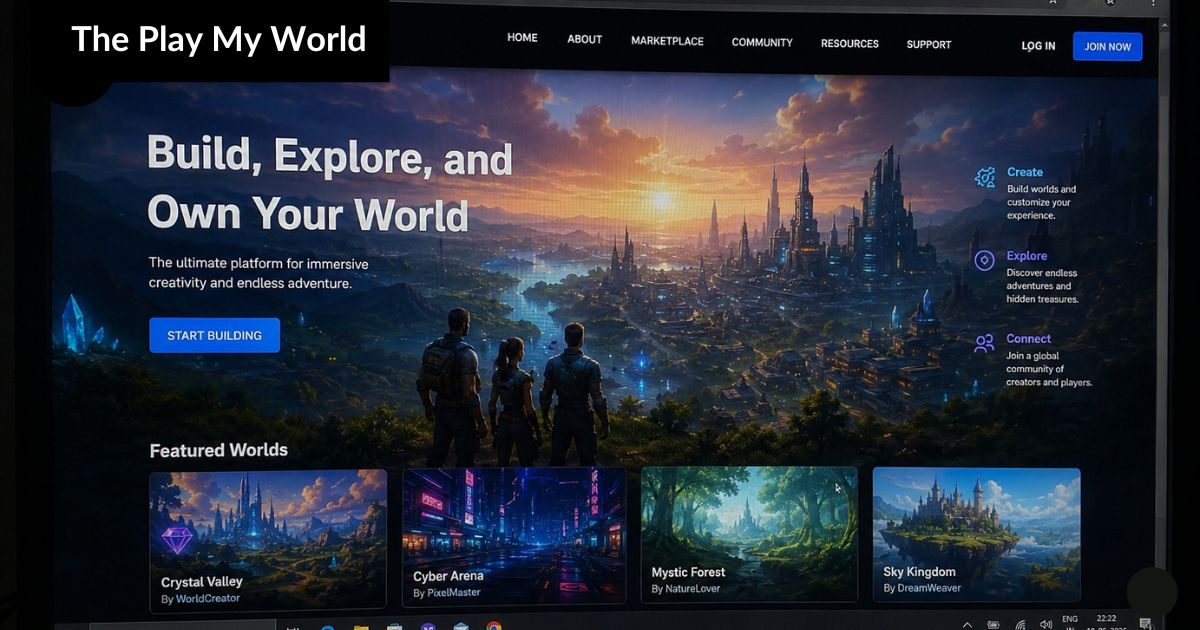
The landscape of digital interaction has undergone a significant transformation, moving toward platforms that prioritize high levels of user agency and collaborative creativity. Central to this evolution is playmyworld .com, a domain that has become a benchmark for “Participatory Entertainment” in 2026. As traditional, static content consumption declines, audiences are gravitating toward environments that allow them to transition from being passive observers to active architects of their own virtual experiences. This strategic shift is driven by a desire for deeper social connectivity and the democratization of digital asset creation.
The platform provides the essential technical infrastructure—utilizing cloud-based rendering and decentralized asset management—to ensure that even complex, multi-layered environments remain accessible to a global audience. Whether you are a professional digital entrepreneur or a casual player looking for a vibrant social hub, understanding the mechanics of this ecosystem is vital. This guide provides a comprehensive overview of the technical innovations, community dynamics, and economic opportunities that define the platform, offering a roadmap for anyone looking to navigate the next generation of the interactive web.
Advancements in Environmental Physics and Rendering
The core of a believable digital world is how it reacts to player interaction. In 2026, the rendering engine has been upgraded to support “Dynamic Material States,” meaning that water, fire, and structural integrity behave with a level of realism previously seen only in high-budget cinema. If a player builds a bridge, the physics engine calculates stress loads in real-time, requiring a basic understanding of engineering to create stable, long-lasting structures. This adds a layer of rewarding complexity to the construction process, making every successful project feel like a genuine achievement.
Furthermore, the lighting systems now utilize real-time global illumination, allowing for stunning visual fidelity across all devices. Whether you are viewing a sunset from the balcony of a custom-built skyscraper or exploring a dark, subterranean cavern, the light reflects and refracts naturally off different surfaces. This visual depth is not just for aesthetic appeal; it serves a functional purpose in gameplay, influencing stealth mechanics and visibility during competitive events. The result is a world that feels “alive” and responsive, providing a tactile sense of presence that keeps players immersed for hours.
The Role of Generative AI in Rapid World-Building
One of the most significant hurdles for new players in sandbox games has historically been the time required to build complex environments. To solve this, the platform has integrated “Assisted Creation” tools powered by generative AI. Players can now use voice commands or simple text prompts to generate foundational landscapes, such as “a dense tropical jungle with a hidden waterfall” or “a sprawling cyberpunk marketplace.” The AI handles the repetitive task of placing thousands of individual assets, allowing the player to focus on the fine details and unique gameplay mechanics.
This democratization of design means that high-quality content is no longer restricted to those with hundreds of free hours. It has led to a massive influx of unique, diverse realms that reflect a wide variety of cultures and artistic styles. Importantly, these AI tools are designed to be “Collaborative, not Competitive.” They provide a starting point that the player must then refine and personalize, ensuring that the human element of creativity remains at the center of every project. This synergy between human imagination and machine efficiency is a hallmark of the 2026 gaming experience.
Social Connectivity and the Rise of Meta-Hubs
Social interaction in the digital age has evolved far beyond simple text chat. The platform now features “Persistent Meta-Hubs”—large, shared social spaces that act as the gateways to millions of user-generated realms. In these hubs, players can attend virtual festivals, participate in live auctions for rare digital items, or simply meet with friends before embarking on a collaborative build. These spaces are designed with “Proximity Audio,” meaning conversations get louder or softer based on how close your avatar is to another player, mimicking real-world social dynamics.
Beyond casual interaction, these hubs serve as the professional networking centers for the platform’s economy. Here, “Master Architects” showcase their portfolios to attract clients, and script developers demonstrate new gameplay mechanics to potential buyers. The social layer is integrated so deeply into the platform that the community has developed its own unique etiquette and cultural norms. This sense of belonging to a “living” world is what drives the high retention rates of the platform, as players find that their digital social lives are just as rich and rewarding as their physical ones.
Security Protocols and User Safety in 2026
With millions of users interacting in real-time, maintaining a safe and respectful environment is a technical and social priority. The moderation system now utilizes “Behavioral Pattern Recognition” to identify and neutralize disruptive players before they can impact others. This AI-driven oversight is supplemented by a robust human moderation team that handles complex disputes. A key feature is the “Safe-Zone Encryption,” which allows realm owners to set strict permissions, ensuring that only trusted friends or verified community members can modify their creations.
Privacy is also a major focus, with the platform adopting “Zero-Knowledge Data Standards.” This means that while the system can verify a user’s age or location for compliance, the raw sensitive data is never stored on a central server where it could be vulnerable to breaches. Users have total control over their “Digital Footprint,” with the ability to clear their interaction history or switch to a “Ghost Mode” for private building sessions. These high standards of security and privacy have made the platform a trusted space for families and professional creators alike, fostering a culture of mutual respect and safety.
The Integration of Educational Frameworks
The educational potential of interactive environments is being fully realized in 2026. Many universities and primary schools have established “Virtual Campuses” within the platform to facilitate immersive learning. For example, a history class might involve walking through a to-scale reconstruction of the Roman Forum, while a chemistry student can conduct “Dangerous” experiments in a simulated lab without any real-world risk. This “Learning by Doing” approach has been shown to significantly increase information retention and student engagement.
Furthermore, the “Visual Scripting” system used to create gameplay mechanics has become a standard tool for teaching basic programming logic. By dragging and dropping “Behavior Blocks,” students learn the fundamentals of variables, loops, and conditional statements. This makes the platform an excellent stepping stone for those interested in a career in software development or game design. The transition from being a consumer of digital content to being a creator is a powerful educational journey that the platform supports at every level, turning play into a productive and skill-building activity.
Economic Sustainability and the Creator Marketplace
A world without a functional economy is just a playground; a world with one is a society. The platform’s internal marketplace has become a multibillion-dollar economy where creators are fairly compensated for their intellectual property. Whether it is a unique avatar skin, a complex puzzle script, or a sprawling adventure map, everything has value. The use of “Smart Contracts” ensures that every time a creation is resold or used in another realm, the original creator receives a royalty payment automatically.
This economic model has empowered a new generation of “Digital Entrepreneurs.” Many players have turned their hobby into a full-time career, managing “Studio Guilds” that produce high-quality assets for other users. The platform provides detailed analytics tools, allowing these creators to track which items are trending and adjust their output accordingly. This data-driven approach to creativity ensures that the marketplace remains fresh and competitive. By providing a clear path to monetization, the platform encourages a high standard of craftsmanship, resulting in a richer and more professional experience for the entire community.
Future Horizons: VR, AR, and Neural Interfaces
As we look toward the next decade, the roadmap for the platform is focused on “Total Immersion.” The integration with the latest generation of lightweight VR and AR headsets allows players to “step inside” their creations with zero latency. The world is no longer confined to a screen; it surrounds the player, responding to their gaze and hand gestures. This level of immersion is particularly effective for collaborative building, where multiple players can stand “inside” a structure as they work on its interior design together in real-time.
Looking even further ahead, experiments with “Neural-Sync” interfaces are already underway. These devices allow for subtle “thought-based” inputs, making the building process feel as natural as thinking. While still in the early stages of testing, these innovations promise a future where the barrier between imagination and digital reality is completely removed. By consistently pushing the boundaries of interface technology, the platform ensures that its ecosystem will remain the central hub for human creativity and social interaction for years to come, leading the way into the era of the spatial web.
Platform Feature Matrix: 2026 Standards
| Feature | Description | Primary Benefit |
| Dynamic Physics | Real-time structural load and material behavior | Realistic / Challenging Builds |
| AI-Assisted Creation | Voice and text-to-world generation | Rapid Prototyping for All |
| Persistent Meta-Hubs | Massive, shared social gateways | Deep Community Connection |
| Smart Contract ROI | Automated royalties for creators | Sustainable Professional Careers |
| Zero-Knowledge Privacy | Verification without data storage | High Level of Personal Security |
| Cross-Platform VR | Native support for spatial computing | Total Immersion & Agency |
Frequently Asked Questions
1. Is playmyworld .com safe for children to use?
Yes, the platform utilizes AI-driven moderation and “Safe-Zone Encryption” to protect younger users. Parents can also set granular permissions and privacy controls to manage social interactions.
2. Can I make real money as a creator on the platform?
Absolutely. The internal marketplace allows you to sell blueprints, scripts, and skins. The integrated “Smart Contracts” ensure you receive royalties every time your work is used or resold.
3. Do I need a powerful computer to build worlds?
No. Thanks to cloud-compute technology, the platform is optimized for everything from high-end desktops to standard smartphones and tablets.
4. How does AI help me build?
AI tools can generate entire landscape foundations based on simple text or voice prompts, handling the repetitive placement of assets so you can focus on fine-tuning and logic.
Conclusion
The evolution of playmyworld .com is a testament to the transformative power of decentralized creativity. By providing a platform that respects both the imagination of the player and the technical requirements of the modern web, the ecosystem has created more than just a game—it has built a foundation for the future of digital life. In 2026, the ability to transition seamlessly between social play, professional creation, and immersive learning is a standard expectation, and this platform meets that expectation with precision.
As we look forward to the innovations of the next few years, the core values of the community—creativity, safety, and transparency—will continue to be the guiding stars. Whether you are an aspiring architect, a social butterfly, or a student of the digital arts, there is a place for you in this ever-expanding universe. The journey from a blank digital canvas to a thriving metropolis is one that millions are taking every day, proving that when we are given the right tools, our collective imagination knows no bounds.
About the Author