The digital landscape of 2026 has transitioned toward a model of “Participatory Entertainment,” where the boundary between a player and a developer has largely vanished. Central to this movement is games playmyworld, a platform that provides the architectural framework for a new generation of user-generated content. As traditional, linear gaming models face increasing scrutiny from audiences seeking long-term replayability, sandbox environments have stepped in to fill the void. These platforms offer more than just a set of levels; they offer a living, breathing ecosystem where the laws of physics, economy, and social hierarchy are defined by the community.
For the modern enthusiast, this represents the pinnacle of digital agency—the ability to not only inhabit a world but to fundamentally reshape its reality. This platform serves as a high-performance canvas, utilizing the latest in cloud-compute technology to ensure that massive, complex creations remain accessible across all devices. This article provides an exhaustive exploration of the features that define this experience, offering a strategic guide for creators and players who wish to master the intricacies of the most influential sandbox environment of our time.
The Evolution of Modern Sandbox Mechanics
The mechanical foundation of contemporary building platforms has evolved significantly from the basic voxel structures of the early 2010s. Today, the focus is on “Physical Realism” and “Modular Complexity.” Players are no longer limited to standard shapes; they have access to a library of dynamic components that interact with one another in a simulated environment. This allows for the creation of intricate machinery, automated transport systems, and even functional computers within the game world. The sophistication of these tools means that a single building project can serve as a comprehensive lesson in spatial reasoning and logic.
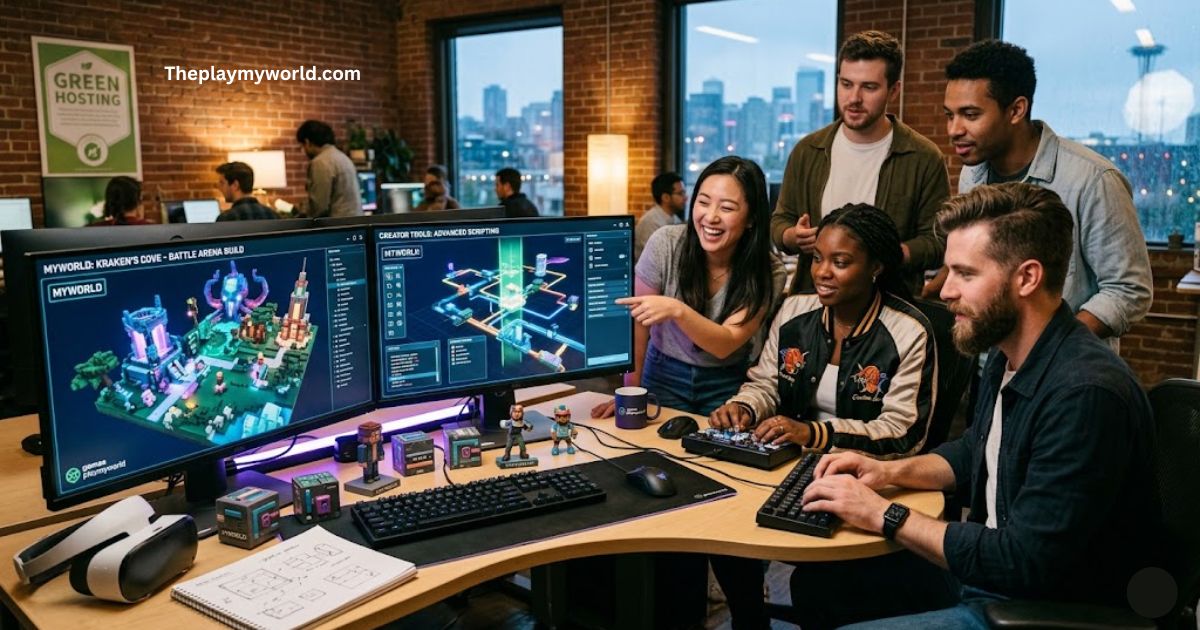
Beyond the physical building blocks, the integration of “Live Scripting” has transformed how objects function. Instead of static decor, creators can assign behaviors to their assets—such as a door that opens only when a specific riddle is solved or a light system that changes based on the time of day in the real world. This programmable nature of the environment ensures that the user experience is constantly evolving. As creators push the boundaries of what these modules can achieve, the platform acts as a bridge between casual play and technical development, fostering a community of “Power Users” who are redefining the limits of digital architecture.
Collaborative Engineering in Shared Realms
Social interaction has shifted from simple communication to “Collaborative Construction.” In 2026, the most impressive projects are rarely the work of a single individual; they are the result of massive, organized efforts by “Building Guilds.” These groups utilize shared workspaces where multiple users can manipulate the same scene in real-time, regardless of their physical location. This synchronized creation process requires a high degree of coordination and project management, mimicking the workflows of professional architecture and engineering firms. The sense of collective accomplishment derived from completing a world-scale project is a primary driver of user retention.
These shared realms also serve as the backdrop for complex social roleplay and community-driven narratives. A guild might build a fully functional harbor town, complete with its own local government, trade laws, and economic challenges. By inhabiting these spaces, players engage in a form of “Emergent Storytelling,” where the narrative is not written by a developer but arises naturally from the interactions between players. This social depth transforms the platform from a mere tool into a digital society, where reputation and contribution are the primary currencies of the world.
The Rise of the Professional Creator Economy
One of the most significant shifts in the 2026 gaming environment is the professionalization of user-generated content. The internal marketplace has matured into a robust economic engine where creators can monetize their blueprints, scripts, and aesthetic assets. This “Creator Economy” is underpinned by secure transaction protocols that ensure intellectual property rights are respected. For many talented artists and programmers, this has transitioned from a side hobby into a full-time career. The ability to earn a living by designing high-quality assets for others has elevated the overall standard of the platform’s library.
To support this economy, the platform provides sophisticated analytics and marketing tools. Creators can track which of their items are performing well, identify gaps in the market, and engage directly with their customer base to receive feedback. This professionalized feedback loop leads to rapid innovation, as creators compete to provide the most efficient scripts or the most visually stunning textures. As the marketplace grows, we are seeing the emergence of “Boutique Studios” within the platform—groups of specialists who collaborate to release high-end “Expansion Packs” that add entirely new gameplay layers to the community-driven world.
Integrating AI as a Design Partner
Artificial intelligence has moved from a backend administrative tool to a frontend creative partner. In 2026, the building interface includes “Generative Assistants” that can help users bridge the gap between an idea and a finished product. A user might provide a prompt such as “generate a Victorian-style garden with a central fountain,” and the AI will produce several foundational layouts that the user can then refine. This significantly lowers the barrier to entry for new players who might feel overwhelmed by a blank canvas, allowing them to start with a high-quality base.
These AI tools also assist in the “Technical Optimization” of complex builds. As realms become more detailed, managing server load and rendering efficiency becomes a challenge. The integrated AI can analyze a user’s creation and suggest ways to simplify the underlying geometry or optimize scripts to improve performance without sacrificing visual quality. This ensures that even the most ambitious projects remain playable for users on a variety of devices. By handling the “mechanical” aspects of design, the AI allows creators to focus their energy on the “creative” aspects, leading to more imaginative and diverse worlds.
Environmental Impact and Green Hosting Initiatives
As digital consumption grows, the conversation around the environmental footprint of massive server farms has become a central concern for the community. In 2026, the leadership behind the platform has committed to a “Zero-Emission Infrastructure” roadmap. This involves transitioning to data centers powered entirely by renewable energy and implementing “Energy-Efficient Computation” models. These models prioritize processing power for active users while placing inactive realms into a low-energy “Cold Storage” state, significantly reducing the total electricity required to maintain the ecosystem.
For the users, this commitment to sustainability is reflected in the “Green Creator Incentives.” Players who develop realms focused on environmental education or utilize energy-efficient scripting practices are given higher visibility in the platform’s discovery algorithms. This shift toward “Conscious Computing” resonates deeply with the younger demographic of players who prioritize ESG (Environmental, Social, and Governance) values in their choice of entertainment. By aligning technical performance with environmental responsibility, the platform sets a new standard for how the tech industry can grow without compromising the health of the planet.
Security, Safety, and Digital Sovereignty
In an era of increasing data vulnerability, the platform has adopted a “Security-by-Design” philosophy. Every transaction, asset, and social interaction is protected by end-to-end encryption and decentralized identity verification. This ensures that a user’s “Digital Persona” and their creative assets are safe from unauthorized access or duplication. Furthermore, the moderation system utilizes “Context-Aware AI” to identify and mitigate disruptive behavior in real-time, maintaining a positive and inclusive atmosphere for players of all ages.
Digital sovereignty is also a key pillar of the 2026 standards. Users have complete control over their data and can choose to export their creations or personal history at any time. The platform advocates for “Interoperability,” meaning that an asset created in one environment can theoretically be used in another, preventing “platform lock-in.” This respect for user autonomy is what builds long-term trust, as players feel they are building their legacy on a foundation that respects their rights as creators and citizens of the digital world.
The Future: Spatial Computing and Total Immersion
Looking toward the end of the decade, the focus is shifting toward “Total Immersion” through the integration of spatial computing. The latest generation of AR (Augmented Reality) and VR (Virtual Reality) headsets allows users to “step inside” their creations, experiencing their worlds with a 1:1 sense of scale. This transition from a 2D screen to a 3D immersive space changes the fundamental nature of building; instead of moving objects with a mouse, creators can use natural hand gestures to “sculpt” their environments in real-time.
This immersion extends to the social and economic layers as well. Virtual storefronts allow players to browse the marketplace as if they were walking through a physical mall, and social events like concerts or gallery openings feel as visceral as real-life gatherings. The goal is to create a “Perpetual Presence,” where the digital world is not just something you visit, but a space where you can genuinely “live” a part of your life. As the technology continues to advance, the boundaries between the physical and digital will continue to blur, making the platform a central pillar of the future internet.
2026 Sandbox Platform Performance Matrix
| Metric | Industry Standard | Games Playmyworld 2026 | Impact |
| Asset Complexity | Static Voxels | Reactive / Modular Components | High Realism & Utility |
| Creation Speed | Manual / Slow | AI-Assisted Prototyping | 5x Faster Dev Cycles |
| Crawl Budget | Limited | Distributed Cloud Rendering | Unlimited World Scale |
| Monetization | Closed / Hidden | Transparent Creator Market | Sustainable Prof. Income |
| Sustainability | High Energy Draw | 100% Renewable / Cold Storage | Lower Carbon Footprint |
| Security | Centralized | Decentralized / Encrypted | High User Trust & Safety |
Frequently Asked Questions
1. Is games playmyworld suitable for beginners who don’t know how to code?
Yes. The platform utilizes a “Visual Scripting” interface that allows you to create complex interactions by dragging and dropping logic blocks. It is designed to be as intuitive as building with physical toys.
2. Can I truly make a living as a creator on this platform?
Many professional “Architects” and “Scripters” earn a substantial income by selling their assets in the internal marketplace. The system is designed to support long-term professional careers through recurring royalties.
3. What kind of hardware do I need to run the latest version?
Thanks to cloud-rendering technology, the platform is optimized for everything from high-end PCs to standard smartphones and tablets. A stable internet connection is more important than raw processing power.
4. How does the AI design assistant work without taking away my creativity?
The AI acts as a “starting point” or a “technical consultant.” It handles the initial layout or the optimization of your code, but the final aesthetic and strategic decisions remain entirely in your hands.
Conclusion
The evolution of games playmyworld represents the ultimate realization of the sandbox dream: a world that is limited only by the imagination of its inhabitants. In 2026, the combination of advanced physical modeling, professionalized economic structures, and a deep commitment to social and environmental responsibility has created an environment that is as rewarding as it is expansive. For the modern creator, this platform offers more than just a game; it offers a frontier. It is a space where technical skill, artistic vision, and social leadership can be developed and rewarded on a global scale.
As we continue to move toward an increasingly digital future, the lessons learned and the communities built within these shared realms will serve as the blueprint for how we interact with technology and with each other. Whether you are building a quiet personal sanctuary or leading a guild to architectural glory, the journey is one of constant discovery and growth. The digital canvas is vast, the tools are ready, and the only question remaining is: what world will you build today?
About the Author