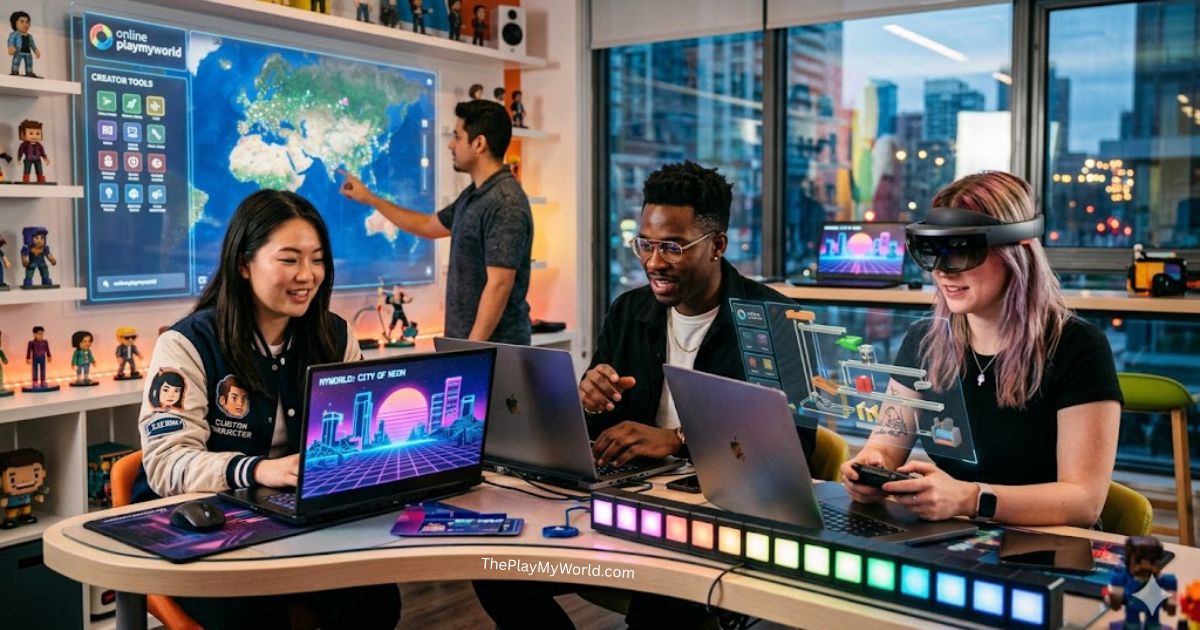
The digital entertainment landscape has shifted dramatically toward platforms that prioritize user agency and collaborative creativity. In this evolving ecosystem, online playmyworld has emerged as a cornerstone for players seeking a blend of social interaction and limitless architectural freedom. As we move through 2026, the demand for immersive environments where users can transition seamlessly from casual gaming to complex world-building has reached an all-time high. This platform caters to that specific need by offering a robust suite of tools that democratize game design, allowing even those without a background in coding to manifest their imaginations in a shared space.
The appeal of such an environment lies in its ability to foster community through shared goals and creative competition. Whether you are a veteran of the sandbox genre or a newcomer looking for a vibrant digital community, understanding the mechanics and social dynamics of this platform is essential. This article provides a comprehensive look at the features, community standards, and technical innovations that make this experience a standout choice for modern gamers.
The Architecture of Creative Freedom
The hallmark of any successful sandbox environment is the depth and accessibility of its building mechanics. Modern players expect more than just static blocks; they demand dynamic materials that react to environmental triggers and complex physics engines that allow for gravity-defying structures. The current iteration of the building engine provides a modular system where every asset can be customized down to its texture and luminosity. This allows for a level of detail that was previously reserved for high-end professional design software. From sprawling medieval kingdoms to neon-drenched futuristic cityscapes, the only limit is the player’s patience and vision.
Furthermore, the introduction of “blueprint sharing” has revolutionized the way the community approaches construction. Instead of starting from scratch, users can import community-vetted skeletons of buildings and then iterate upon them. This collaborative spirit speeds up the development of massive world-scale projects, enabling groups of players to construct entire functional cities in a fraction of the time it would take a solo creator. By lowering the barrier to entry while maintaining a high ceiling for mastery, the platform ensures that both casual decorators and master builders find value in the creative process.
Social Dynamics and Collaborative Play
Gaming is no longer a solitary activity; it is a shared social experience that mirrors real-world networking. The social layers integrated into the platform allow for seamless communication through proximity-based voice chat and expressive avatar animations. Players often organize into “Guilds of Creation,” which are formal groups dedicated to specific themes or competitive objectives. These social structures provide a sense of belonging and purpose, as members work together to defend their territories or win community-voted design awards. The interaction is not just about the game; it is about building lasting digital friendships.
In addition to formal groups, the platform hosts regular “Meta-Events“—large-scale, developer-organized gatherings that involve thousands of players simultaneously. These events might range from virtual concerts and fashion shows to massive scavenger hunts across multiple user-generated realms. These moments of collective participation create a shared history within the community, where players can look back on specific “seasons” of the world as distinct cultural eras. This high level of social engagement is what keeps the ecosystem vibrant and resilient against the competition of traditional, linear gaming experiences.
Technical Performance and Cross-Platform Stability
To support thousands of simultaneous users in highly detailed environments, the underlying infrastructure must be exceptionally robust. The 2026 technical stack utilizes “Edge-Compute” technology, which offloads much of the heavy rendering tasks to local servers closer to the user. This drastically reduces latency and ensures that even players on mobile devices or entry-level laptops can enjoy a smooth, high-fidelity experience without significant frame rate drops. This commitment to accessibility is a major factor in the platform’s global growth, particularly in regions where high-end gaming hardware is less prevalent.
Security and stability are also top priorities for the developers. A “Multi-Layered Sharding” approach is used to prevent server overloads during peak hours. This means that while the world feels like one continuous space, it is actually a series of interconnected instances that balance the load dynamically. Additionally, integrated anti-griefing protocols protect user creations from unauthorized modifications. These technical safeguards provide peace of mind for creators who spend hundreds of hours on their projects, knowing that their work is hosted on a secure, high-performance network designed for longevity and resilience.
Economic Ecosystems and Digital Ownership
A thriving digital world requires a functional economy that rewards creativity and participation. The internal marketplace allows users to trade custom skins, building modules, and even unique gameplay scripts using a secure in-game currency. This “Creator Economy” provides a legitimate path for talented artists and developers to monetize their skills. By selling a popular furniture set or a complex puzzle mechanic, a user can earn enough currency to fund their own massive projects or trade for rare aesthetic items that signal their status within the community.
The concept of digital ownership has been strengthened through the use of decentralized ledgers for high-value items. This ensures that when a player acquires a “Legendary Blueprint,” they have a verifiable record of ownership that exists independently of a single server. This move toward “Persistent Assets” gives the items real-world psychological value and encourages long-term investment in the platform. As the economy matures, we are seeing the rise of “Digital Consultants”—players who are hired by others to design or optimize their realms, creating a professional services layer within the game itself.
Educational Potential and Skill Development
Beyond entertainment, sandbox platforms are increasingly recognized for their educational value. The logic systems used to create interactive elements in the world serve as a “Gateway to Coding.” By using visual scripting blocks, younger players learn the fundamentals of “if-then” logic, loops, and variables without the frustration of syntax errors. Many schools and coding bootcamps have begun utilizing these environments to teach spatial reasoning, project management, and collaborative problem-solving in a way that feels like play rather than work.
The platform also encourages historical and scientific exploration through community-led “Edu-Realms.” These are worlds meticulously built to replicate historical sites like the Great Library of Alexandria or scientific concepts like the inner workings of a human cell. By walking through these 3D representations, students gain a visceral understanding of the subject matter that textbooks cannot provide. This “Immersive Learning” model is a powerful tool for modern educators, proving that a well-designed gaming platform can be a formidable asset for intellectual and creative growth across all age groups.
Safety, Moderation, and Community Standards
Maintaining a healthy environment in a massive online space requires a sophisticated approach to moderation. The platform utilizes “AI-Assisted Oversight,” where machine learning models scan text and voice chat for violations of the community code of conduct. These tools can identify bullying, hate speech, or inappropriate content in real-time, allowing human moderators to focus on complex disputes. This proactive stance on safety is essential for ensuring that the world remains a welcoming space for players of all ages and backgrounds.
User-led moderation is another key component. Realm owners have total control over the “permissions” within their specific spaces, allowing them to whitelist friends or set strict rules for public visitors. A “Reputation System” also helps the community self-regulate; players who are consistently helpful and creative earn “Commendation Points,” while those who engage in disruptive behavior find themselves restricted from certain high-profile social hubs. This balance between automated systems and community agency creates a self-sustaining culture of respect and accountability that is rare in the broader internet landscape.
Future Innovations and the Spatial Web
As we look toward the 2030s, the platform is preparing for the transition to the “Spatial Web,” where the boundaries between physical and digital spaces become increasingly blurred. Integration with the latest augmented reality (AR) glasses will allow users to project their creations into their real-world living rooms or collaborate with others in a hybrid environment. The goal is to move from a “windowed” experience on a screen to a “pervasive” experience where your digital world is an extension of your physical reality.
The developers are also experimenting with “Neural-Sync” interfaces, which allow for more intuitive control schemes based on gaze tracking and subtle gestures. This will make the building process even more fluid, allowing for “Thought-to-Object” creation where the interface disappears, leaving only the player and their imagination. By staying at the bleeding edge of interface technology, the platform ensures its relevance for the next generation of digital natives. The journey from a simple building game to a comprehensive digital lifestyle platform is well underway, promising a future where online playmyworld is limited only by the human capacity to dream.
Platform Features Comparison: 2026
| Feature | Standard Sandbox | Online Playmyworld 2026 | Benefit |
| Building Engine | Static Blocks | Modular / Reactive Materials | Realistic / Detailed Designs |
| Logic Tools | Basic Switches | Visual Scripting / Logic Blocks | Learn Coding Fundamentals |
| Connectivity | Centralized Servers | Edge-Compute / Sharded | Zero-Lag / Global Access |
| Economy | Consumables Only | Persistent Assets / Blueprints | Real Creator Monetization |
| Social | Text Chat | Proximity Voice / Meta-Events | Deep Community Bonds |
| Moderation | Reactive / Manual | AI-Assisted / Real-Time | Safe / Inclusive Environment |
Frequently Asked Questions
1. Is online playmyworld safe for younger children?
Yes, the platform features robust parental controls and AI-driven moderation that filters out inappropriate content and communication. Parents can also restrict their children to private realms for added safety.
2. Can I make money by creating content on the platform?
Absolutely. The internal marketplace allows creators to sell their blueprints, skins, and scripts to other players for in-game currency, which can often be used for various platform perks or premium upgrades.
3. What devices are compatible with the current version?
The 2026 engine is optimized for cross-platform play, supporting PC, Mac, high-end smartphones, tablets, and the latest generation of VR/AR headsets.
4. Do I need to know how to code to build complex machines?
No. The visual scripting system uses a “drag-and-drop” interface that allows you to create complex interactions and games within the world without writing a single line of code.
Conclusion
The evolution of online playmyworld reflects a broader human desire for a space that balances personal expression with collective experience. By providing the tools for complex creation and the social infrastructure for meaningful interaction, the platform has transcended the label of a mere “game.” It is a digital laboratory, a social club, and an art gallery all rolled into one. As technical barriers continue to fall and the community grows more diverse, the impact of this platform on how we spend our digital lives will only deepen.
Whether you are building a solitary retreat or leading a massive guild to architectural glory, the opportunities for discovery are endless. The 2026 landscape of interactive gaming is bright, fueled by the creativity of millions of users who have found a home in this expansive, ever-changing world. Entering this space is more than just a pastime; it is an invitation to participate in the construction of the future of play.
About the Author